Faith Based Recovery Programs & Outreach in Southern Colorado
Iron House Transitional Recovery Housing Model
“Anyone willing to change can come home.” That saying sums up Iron House. Our transitional housing program provides more than a roof and a bed – it offers a Christ-centered family environment for men and women serious about recovery.
Our Model
Iron House homes are peer-led sober living environments grounded in Christian principles. There is no hired staff or managers. Instead, residents govern the house together, electing house officers, voting on decisions, and holding each other accountable. This approach, inspired by the successful Oxford House™ model, gives each person responsibility and a sense of ownership in their recovery journey
What makes Iron House unique is that we didn’t stop at peer management – we added what was missing: Jesus at the center of the home and servant-leader oversight for guidance. Trusted Christian mentors (we call them “trusted servants”) visit regularly to provide support, conflict mediation, and spiritual counsel. They are there to serve, not to control, ensuring the house stays safe and on track without undermining resident responsibility. It’s a healthy balance of freedom and support.
Life in an Iron House
All residents commit to a structured but supportive routine:
🛡️ Maintain Sobriety: Zero tolerance for drugs/alcohol; random drug tests are conducted.
🕙 Curfews & Chores: Everyone abides by curfew (typically 10 PM for new members, unless work-related) and shares daily/weekly chores to keep the home running smoothly.
🤝 Recovery Meetings: Residents actively work a recovery program of their choice (AA, NA, Celebrate Recovery, etc.) and attend a weekly in-house meeting. Optional Bible studies and group prayers are also available.
💵 Shared Expenses: Iron House is self-sustaining; residents contribute an equal share of house expenses (rent, utilities, and basic supplies). Scholarships or assistance may be available, especially during the first month.
🏠 House Meetings: Weekly house meetings are held to discuss issues, vote on decisions (such as accepting new members), and review one of the Eight Principles together, keeping everyone aligned and supported as a family.
Grace Meets Accountability
We welcome people from any faith background (or none at all) – you do not have to be a Christian to live in Iron House. What we do ask is that everyone show respect for our Christ-centered approach and participate in the community in good faith. Many come in just looking for sobriety and end up finding faith; others come in firm in their beliefs. All are treated with love and respect. By weaving biblical principles of forgiveness, honesty, and accountability into daily life, Iron House creates an atmosphere where real heart change can happen. It’s not just about avoiding drugs or alcohol; it’s about learning to live in freedom and truth.
Outcomes
Iron House began with our men’s home (often referred to as Iron House One in Pueblo). In a short time, we’ve seen men go from homelessness to holding jobs, from estranged to reunified with family, from hopeless to hopeful. The peer-led, faith-supported model works — not as a magic formula, but because God honors surrender, community, and hard work. We don’t measure success in big numbers; we measure it in restored lives: every sobriety anniversary, every reconciled relationship, every resident who “graduates” to independent living with a firm foundation. These are the wins we celebrate.
Iron House Indian Bend (Pueblo West) – Women’s Home
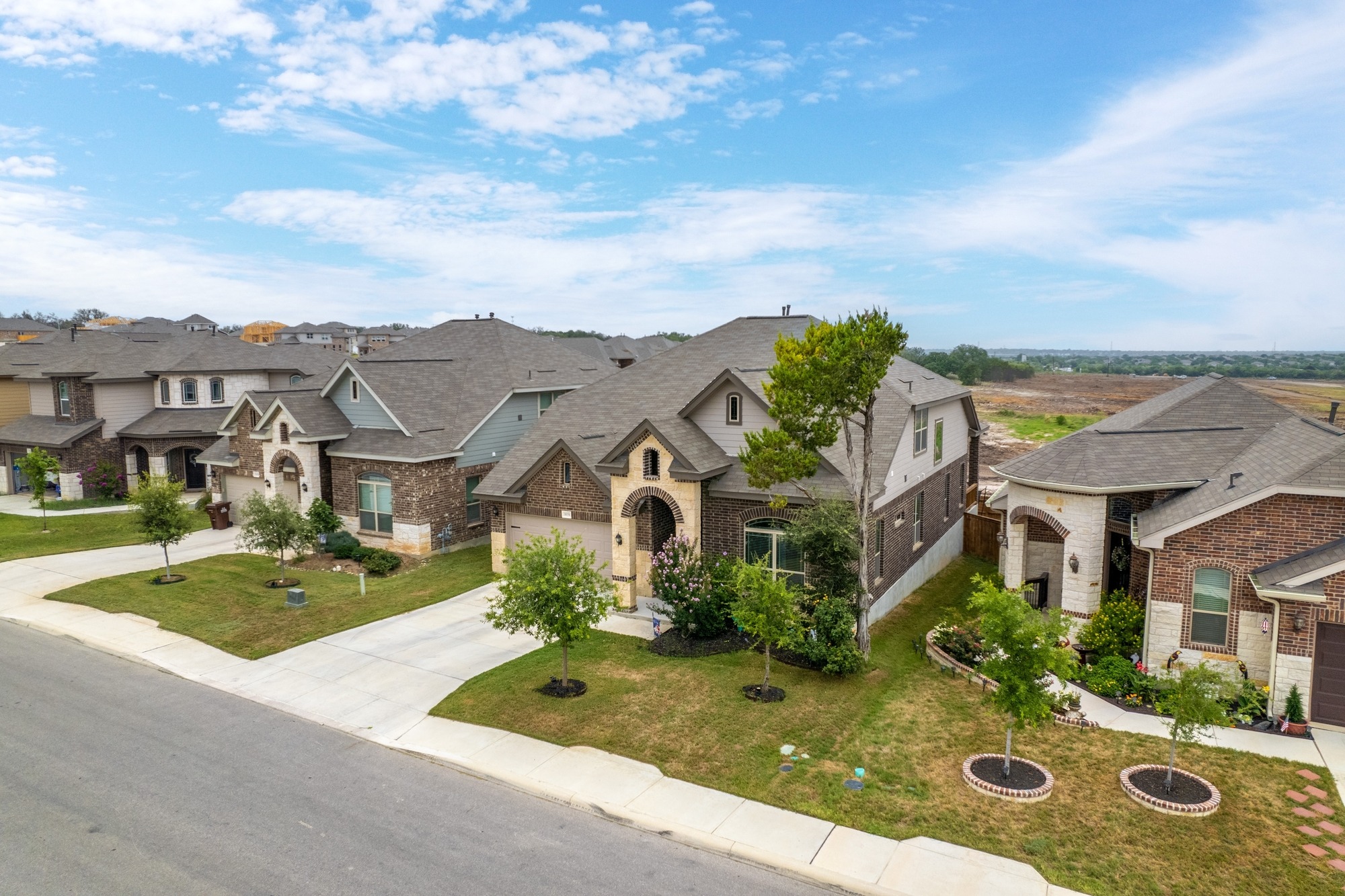
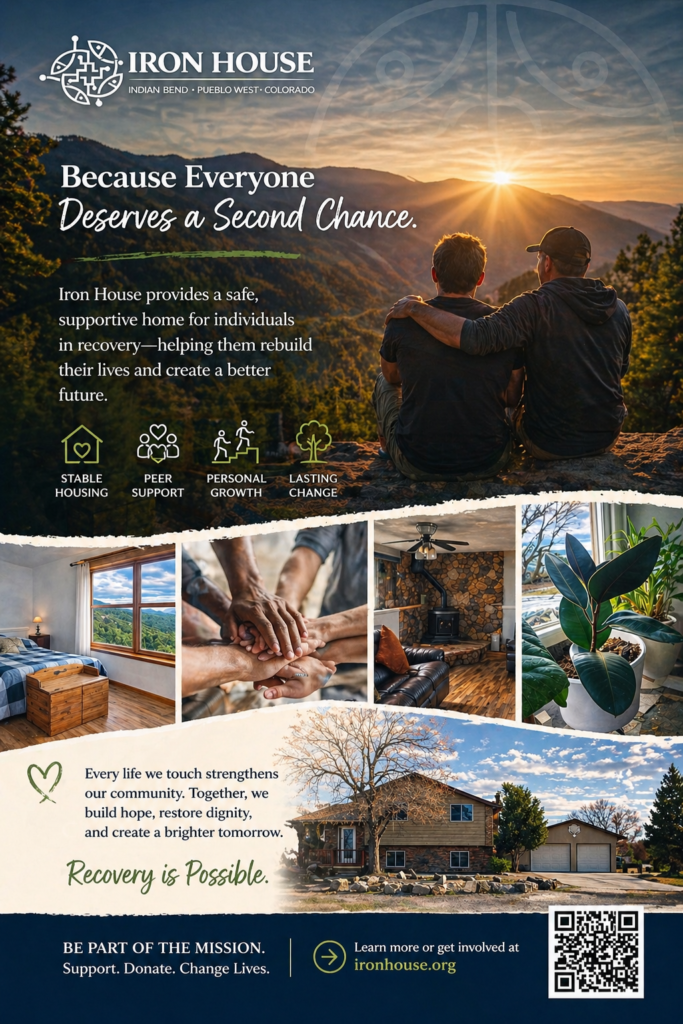
We are excited to announce that our second transitional home, Iron House Indian Bend, is now open! This home is dedicated to women in recovery, including mothers who need a safe place where their children are welcome. Located in a quiet neighborhood in Pueblo West, Iron House Indian Bend operates on the same principles as our original house, tailored to a family-friendly setting. Up to 8 women (plus kids) live together, supporting one another like sisters as they rebuild their lives.
Key Features
Safe & Faith-Centered Recovery
🕊️ A safe, structured, God-centered environment for women overcoming addiction, trauma, or other life challenges.
Support for Mothers & Children
👩👧Accommodations for mothers with young children — providing an understanding community where moms and little ones can heal and grow together.
Structured Peer-Led Living
🏠Follows the Iron House model — democratically run with no live-in staff, featuring curfews, chore rotations, weekly house meetings, and a focus on the Eight Principles.
Supportive Community
🤝Women at Indian Bend encourage one another, attend recovery meetings together or individually, and hold each other accountable in love. There is a strong spirit of grace, healing, and sisterhood where everyone is committed to moving forward together.
Trusted Servants
💜 Female mentors from our ministry visit regularly to provide guidance, help with any conflicts, and offer spiritual support. They ensure the house remains a safe haven and that each mom and child is cared for.

How to Apply (Indian Bend)
“Anyone willing to change can come home.” That saying sums up Iron House. Our transitional housing program provides more than a roof and a bed – it offers a Christ-centered family environment for men and women serious about recovery.
1. Submit an Application
2. Interview
After we receive your form, we’ll reach out to schedule an interview (either by phone or in person). In this interview, you’ll meet with our housing committee or current house members, and together we’ll review an Initial Recovery Plan that you fill out. This plan lets you outline your goals and commitments if you join the house.
3. Acceptance
If approved by the committee and current residents, you’ll be offered a spot in the home. We’ll work with you to set a move-in date (this could be as soon as the same day, or within a week).
4. Move-In Day
On the agreed date, you’ll come to the house, take a quick urinalysis (UA) drug test, and if clean, proceed with move-in. There is a $300 move-in fee, which covers your first period of expenses – however, currently we have scholarships available, so this fee and your first 30 days of housing costs are covered for all new residents! We’ll help with bags, give you a door code, and introduce you to your housemates.
5. Trial Period
All new residents start on a trial membership (usually the first 30 days). During this time, you’ll need to follow the basic house rules closely: 10 PM curfew (unless working late), attend weekly house meetings, perform your assigned chores, remain abstinent from all drugs/alcohol, and work on the recovery goals you set in your plan. It’s a chance for you and the house to ensure it’s a good fit. After the trial, if all goes well, you become a full voting member of the house.
Important: We cannot accept individuals with a history of arson or violent sexual offenses. Safety is paramount for all residents, especially where children are involved.
Iron House Indian Bend is now accepting applications. Space is limited, so don’t wait to reach out if you’re interested. Even if the house is full, we will do our best to connect you with other resources or put you on a waitlist.
We are grateful to everyone who helped make Indian Bend possible. It’s meeting a huge need in our community for women and children in recovery. Please pray with us for each family that finds refuge here.
Iron House Home Services
Iron House Home Services (IHHS) is our hands-on workforce development program and social enterprise. It was born from a simple observation: many people in recovery need job skills and work experience, and many vulnerable homeowners in our community need affordable help with home repairs. IHHS brings these needs together in a Christ-inspired way.
Through this program, men and women in recovery get the opportunity to learn skilled trades – such as heating and air conditioning (HVAC), basic plumbing, electrical work, carpentry, and general home maintenance – by working on real projects in the community. Under the guidance of licensed contractors and experienced volunteers, our participants serve elderly, disabled, or low-income neighbors who cannot afford critical repairs.
How It Works
🔧 Hands-On Home Repairs: We take on projects like fixing furnaces, installing air conditioners, repairing leaky sinks, patching drywall, and other household repairs. No job is too small if it helps someone in need and provides a learning opportunity.
👷 Mentorship & Skilled Training: Experienced tradespeople who volunteer or work with us part-time mentor trainees on the job. Safety and quality are top priorities, so all work is supervised and carefully checked.
💛 Affordable & Community-Focused Service: Whenever possible, we provide repairs for free or at minimal cost for those who truly can’t pay. For clients who can afford services, fair rates are charged, and all revenue goes directly back into the program to support tools, stipends, and expansion.
📈 Fresh Starts Through Apprenticeships: Participants are often Iron House residents or alumni, though we also welcome others in recovery seeking a new beginning. Trainees start as volunteers and, as funding grows, can transition into paid apprenticeship opportunities while learning valuable trade skills.
Impact
In our pilot year (2024), Iron House Home Services:
🏡 Serving Families in Need: Performed free repairs for multiple families in Pueblo — including fixing heaters during winter for seniors, installing an AC unit for a local recovery center, and making safety improvements like smoke detectors and wheelchair ramps.
🛠️ HVAC Training & Recovery Growth: Trained three Iron House residents in HVAC basics under the mentorship of a certified HVAC technician. Participants learned tool usage, basic diagnostics, and professional customer interaction while building confidence and strengthening accountability in their sobriety journey.
🤝 Trusted Community Partnerships: Built a reputation in the community as a reliable helping hand. Churches, nonprofits, and local organizations have partnered with us because they recognize the value and impact of the work being done through Iron House Home Services.
Encouraged by these results, we’re expanding. In 2025–2026, our goal is to operate IHHS as a
sustainable social enterprise: hiring some trainees as entry-level staff, increasing the volume
of paid jobs (to fund the free work), and broadening the skills we can teach (potentially adding
certified training modules). We’ve even created a dedicated website for this arm of our ministry
– you can visit IronHouseHVAC.com for more details and updates specifically on the work
program.How to Get Involved or Request Service
🆘 Need a Hand? If you are in the Pueblo area and can’t afford a repair — or know someone who needs help with their home — please contact us. We evaluate requests based on urgency and training opportunities for our participants. While we can’t promise to fix everything, we will do our best to help or connect you with someone who can.
🏠 Hire Our Crew: If you have a maintenance or small renovation project and would like to support the mission financially, Iron House Home Services provides quality work while helping individuals in recovery gain valuable experience and purpose.
🤲 Volunteer or Partner: Skilled tradespeople — including plumbers, electricians, HVAC techs, carpenters, and more — are invited to volunteer as mentors or partner with us through discounted supplies, services, or employment opportunities for graduates of the program.
Iron House Home Services is more than a jobs program – it’s about showing that work can be
therapy and service can be healing. When our participants fix a broken furnace for someone,
they tangibly see that they have something to offer the world. Dignity and purpose are restored
along with that furnace. That’s the power of combining faith, work, and compassion.
Iron House Content (Media & Outreach)
🎥 Stories of Hope & Recovery: Stories have power — especially stories of hope. Iron House Content is our media hub where we share powerful testimonies of changed lives and engage the community in conversations about addiction, faith, and recovery. The shame that keeps people in darkness begins to lose its grip when exposed to the light of real and honest stories. Through videos, podcasts, articles, and outreach media, we aim to proclaim a simple truth: no one is beyond God’s reach, and there is hope for everyone.
What You’ll Find:
🎙️ Testimony Videos & Podcasts: We feature unscripted interviews with people who have overcome addiction — including Iron House residents, alumni, and others in the recovery community. These stories explore where they’ve been, how they encountered God and support during their darkest moments, and what life in recovery looks like today. Every testimony points toward hope, healing, and transformation.
🎥 The “Why Project” Series (Coming Soon): Our outreach team visits local streets, parks, and shelters to meet people who are struggling and hear their stories. With permission, some conversations are shared through raw and honest mini-documentaries that aim to give a voice to the voiceless, foster compassion, and reveal the real needs facing the community. It’s part ministry, part journalism, and fully centered on showing God’s love in action.
📚 Blog Articles & Recovery Resources: Through our website and social media, we share practical and encouraging content such as detox resources in Pueblo, Scriptures for overcoming addiction, guidance for families, mental health support, and educational articles that help break stigma and offer hope.
📱 Inspiration on Social Media: We create short-form content including inspirational quotes, quick testimony clips, before-and-after stories, and recovery encouragement designed to spread hope online. Follow @IronHouseOne on Facebook, Instagram, X (Twitter), Threads, TikTok, and YouTube to stay connected and help share the message that recovery is possible.
Why We Do It
✨ Why We Share These Stories: Everything we create through Iron House Content has one purpose — to glorify God by sharing His power to change lives. We want to replace judgment with understanding, fear with compassion, and hopelessness with truth. If even one person chooses recovery after hearing a testimony, or one family finds hope that restoration is possible, then every video, article, and outreach conversation is worth it.
🌙 Reaching People Where They Are: Iron House Content helps us connect with people who may never walk through the doors of a church or recovery meeting. Someone struggling at rock bottom may come across a testimony video late at night searching for hope. In that moment, we want them to hear this message clearly: “You are not alone, and there is hope.”
📣 More Stories Coming Soon: We’re continuing to expand our videos, outreach, and resources to reach more lives with encouragement and truth. If you have a testimony to share or an idea for content, we would love to hear from you. This platform is bigger than Iron House itself — it’s about sharing God’s grace and the reality that transformation is possible for anyone willing to seek help.